What is AI search visibility?
AI search visibility is whether an assistant names your business when someone asks it a question you could have answered. It covers Google’s AI Overviews and AI Mode, and the assistants that summarise the web before the reader clicks anything.
Most of what is sold as a separate discipline for this is not one. Google’s own documentation for site owners is explicit that there are no extra requirements and no special markup involved in appearing in its AI features.
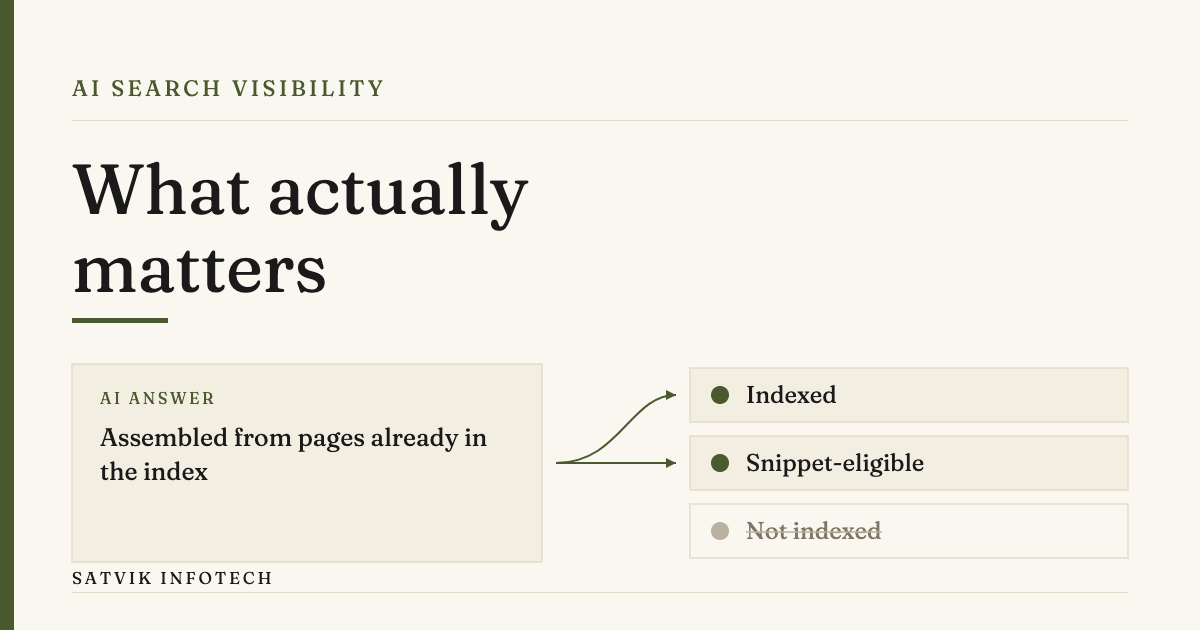
- Being indexed is the only hard gate. A page has to be in the index and eligible for a snippet before it can be cited at all.
- No special schema is required. There is no AI-specific structured data type to add.
- No AI text file is required for Google’s AI features,
llms.txtincluded. - The fundamentals decide it: crawlable pages, content in real text, internal links, and markup that matches what the reader sees.
- You cannot measure it on its own. Search Console folds AI features into the ordinary Web search type.
What Google actually says you need
Google publishes a page for site owners called AI features and your website, and it is shorter than you would expect. It says the usual SEO best practices remain relevant for AI Overviews and AI Mode, that there are no additional requirements to appear in them, and that no other special optimisations are necessary.
It is blunter still about the two things most often sold as AI-specific work. There is no special schema.org structured data to add, and in Google’s words you do not need to create “new machine readable files, AI text files, or markup” to appear in these features. Both statements were checked at source on 19 September 2026.
That does not mean nothing matters. It means the work that matters is the work that already mattered, which is a harder thing to sell and a cheaper thing to do.
| The claim | What the documentation says |
|---|---|
| Add AI-specific structured data | No special schema.org structured data is needed for AI Overviews or AI Mode. |
Publish an llms.txt so assistants can read the site |
Not required for Google’s AI features. Other assistants may read such a file; Google’s do not need it. |
| Optimise separately for AI | No additional requirements and no special optimisations. The same SEO fundamentals apply. |
| FAQ markup earns a rich result | The FAQ rich result is shown only for well-known, authoritative government and health sites. |
| How-to markup earns a rich result | That rich result is no longer shown at all, and its documentation has been withdrawn. |
| Report on AI traffic separately | AI features are counted inside the ordinary Web search type in Search Console. |
The only hard requirement is being indexed
To be eligible as a supporting link in an AI Overview or in AI Mode, a page has to be indexed and eligible to be shown in Google Search with a snippet. Google states there are no additional technical requirements beyond that. It is a low bar in principle and the one most small sites actually fail.
Google is also candid that meeting every requirement earns nothing automatically, because crawling, indexing and serving are not guaranteed. A page can be technically sound, internally well linked, and still sit unindexed for weeks.
So the first question is never which assistant to optimise for. It is whether the page is in the index at all, which you can check for any URL in Search Console. If it is not, no amount of markup will put it into an answer.
Query fan-out changes what a page has to be
Both AI Overviews and AI Mode may use what Google calls a query fan-out. Rather than answering the typed question directly, the system issues several related searches across subtopics and data sources, then assembles a response from what comes back.
That has a practical consequence most advice misses. One long page trying to cover an entire topic competes for a single one of those subtopic searches at best, while a set of pages that each answer one question completely can be pulled into several of them.
It is also why a question-shaped heading followed by a short, self-contained answer is worth more than the same sentences buried mid-article. We keep a page of plain answers to the questions buyers actually ask for that reason, and it is the cheapest structural change most sites can make.
The same logic applies to choosing what to write at all. Looking at what competitors already rank for tells you which subtopics are genuinely contested before you spend a week on one.
What actually moves the needle
Google’s list of what still counts for AI features is a list of ordinary hygiene, which is either reassuring or disappointing depending on what you were hoping to buy. Every item on it is something you can check yourself.
- Let the crawlers in. Not only in
robots.txt, but through any CDN or host protection sitting in front of the site. - Link your own pages together. Internal links are how content gets found, and how a search engine works out which page answers what.
- Put the important content in text. Anything that exists only inside a script, an image or a video cannot be summarised.
- Keep structured data matching the visible page. Markup describing content a reader cannot see is a liability, not an optimisation.
- Give people a decent page experience, which is the same reason responsive design still underpins search performance.
- Keep the Business Profile current, because a great many local answers are assembled from it.
The third item is the one that quietly breaks modern sites. A page that renders its content in the browser rather than serving it as text can look empty to anything that does not run JavaScript, which matters most for interactive products and is worth settling early when you commission custom web and mobile application development.
The fourth is ongoing work rather than a one-off job. Copy gets edited and markup does not, so the two drift apart until the schema describes a page that no longer exists. Catching that is part of what ongoing website and automation maintenance covers.
The controls, and what each one costs
If the question is not how to get into AI answers but how to stay out of them, the controls are worth understanding before anyone edits a template, because most of them cost more than people expect.
| Control | What it limits | What it costs |
|---|---|---|
robots.txt for Googlebot |
Crawling for Search as a whole | Everything. AI features are built into Search, so blocking Googlebot removes you from both. |
noindex |
Indexing of that page | The page leaves Search, and with it any chance of being cited in an AI answer. |
nosnippet, data-nosnippet, max-snippet |
How much of the page can be shown | Limits AI features, and equally limits ordinary snippets, which is usually where the clicks come from. |
Google-Extended |
AI training and grounding in some of Google’s other systems | Nothing in Search itself, which makes it the only one of the four with a contained cost. |
The honest reading is that there is no clean way to stay in Google Search while staying out of AI Overviews. The same controls govern both, and three of the four cost you the ordinary listing as well. If that trade matters, it is a decision for the business rather than for whoever edits the templates.
What we do on this site, and what we do not
This site publishes an llms.txt, keeps a page of question-shaped answers, mirrors every visible FAQ into FAQPage markup, and allows the assistant crawlers in robots.txt. None of that is a growth hack and we would not sell it as one.
Two honest notes on it. Our own URL inspections report exactly one rich result type on these pages, Breadcrumbs, and never an FAQ result, which is what you would expect given Google restricts that feature to government and health sites. We keep the FAQ markup regardless, because assistants parse it and because it costs nothing to maintain beside copy that has to be written anyway.
The llms.txt is the same kind of decision: not required by Google, cheap to keep accurate, plausibly useful to assistants that do read it. What we will not claim is that it changes rankings.
What we actually sell starts after the click. An AI answer that names you still sends a stranger to a form, and the next few minutes decide whether that becomes a customer, which is why replying to every enquiry within five minutes matters more than the ranking that produced it.
That part we do build: the CRM setup and management and the workflow automation that answer, route and follow up an enquiry without anyone remembering to. If the plan is to let software handle the first reply, it is worth reading what AI automation actually means and how a chatbot compares with live chat and a plain form first.
The short version: get the page indexed, write the answer where a reader can see it, and keep the markup honest. Most of what is sold as AI search strategy is either that same work under a new name, or something Google has said you do not need.
AI search visibility questions, answered
Do I need an llms.txt file?
Not for Google. Its site-owner documentation says you do not need to create machine readable files, AI text files or markup to appear in AI Overviews or AI Mode. Some other assistants do read such a file, and it is cheap to publish and keep accurate, so treat it as housekeeping rather than as an optimisation.
Is answer engine optimisation a real discipline?
The goal is real, but the separate discipline mostly is not. Being cited by an AI answer is the same work as being findable in search: indexable pages, content in plain text, clear internal links, and answers that stand on their own. If someone sells AEO as a distinct technical service with its own markup, ask which requirement it satisfies that ordinary search does not.
Can a page appear in an AI Overview without being indexed?
No. Google's stated requirement is that the page is indexed and eligible to be shown in Search with a snippet, with no additional technical requirements beyond that. Indexing is also not guaranteed, so a page can be complete and correct and still wait weeks before it is eligible for anything.
Can I stay in Google Search but keep out of AI Overviews?
Not cleanly. Google describes AI as built into Search, so the same controls govern both: robots.txt for Googlebot, noindex, and the snippet controls. Each of those costs ordinary search visibility as well, which is usually a worse trade than the thing it prevents.
How do I tell how much traffic comes from AI answers?
Largely you cannot, at least not in Search Console. Google reports AI features inside the ordinary Web search type rather than splitting them out, so impressions and clicks from an AI Overview sit mixed in with everything else.
Google has said clicks from results pages carrying an AI Overview tend to be higher quality, meaning people spend longer on the site. That is a statement about behaviour rather than a figure you can pull for your own site.