Why the first reply wins
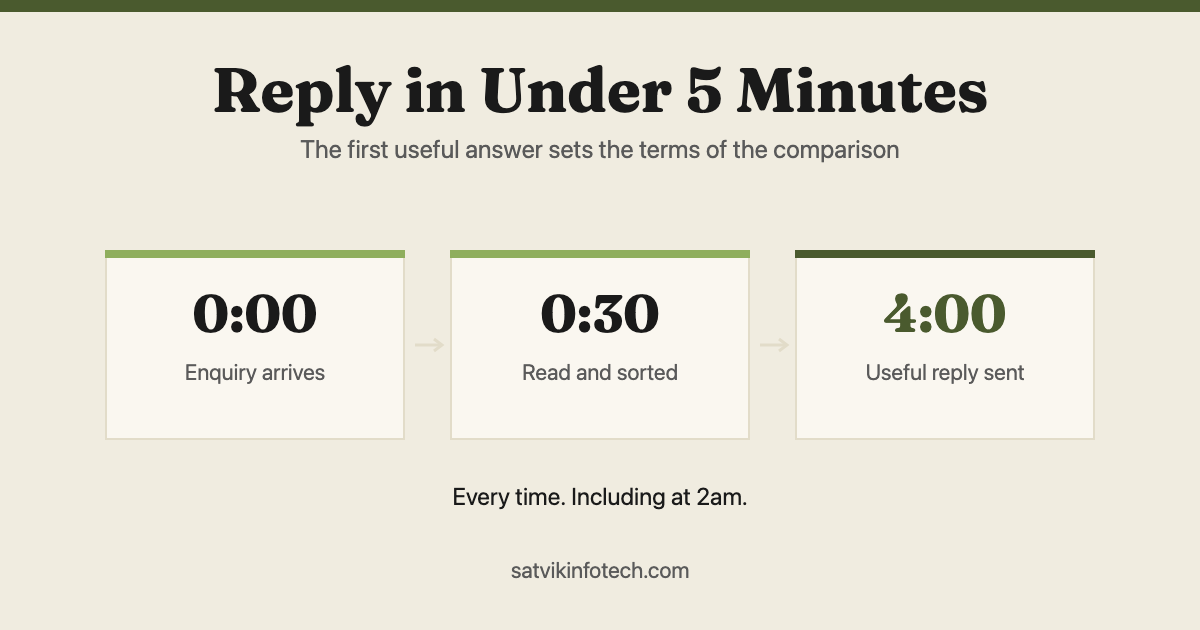
Somebody filling in your form is almost never filling in only yours. They are comparing three suppliers, and the one who answers first gets to set the terms of the comparison.
It is also worth knowing how they found you in the first place, because an assistant that summarises three suppliers is now often the thing doing the comparing. That is a separate question with a shorter answer than most people expect.
- You frame the conversation. The first supplier to reply defines what the questions are. Everyone after that is answering your framing.
- Intent decays fast. Someone who has just described their problem is engaged. The same person two days later has moved on to something else.
- Speed reads as competence. Fairly or not, people take a fast reply as a signal about how you will handle the work itself.
- It is the cheapest improvement available. It wins more from the enquiries you already have, without spending anything on getting more.
Speed alone is not the point
Most instant-reply automations make things worse, and it is worth being clear about why before building one.
They send an acknowledgement. "Thank you for your enquiry, a member of our team will be in touch." That message tells the reader two things: their enquiry reached a machine, and nothing has actually happened yet.
A fast, empty reply is not better than a slow, useful one. The goal is a first reply that is both quick and worth reading, which is a harder thing to build and the only version that pays.
What the first reply should contain
The difference between an automation that wins work and one that annoys people is entirely in the content of that first message.
| Element | The version that annoys | The version that works |
|---|---|---|
| Opening | "Thank you for your enquiry" | References what they actually asked about |
| Substance | None. It confirms receipt | Answers the obvious first question, or rules something out |
| Who it is from | "The team" | A named person who will actually be handling it |
| Next step | "We will be in touch" | A booking link, or a specific time you will call |
| If they reply | Goes to an unmonitored inbox | Reaches a person, and the automation gets out of the way |
What actually happens in those five minutes
Underneath, this is a short chain of steps, none of them clever on its own. The value is that it runs every time, including at midnight and on a Saturday.
- The enquiry lands and becomes a contact in the CRM, tagged with where it came from.
- It gets read and sorted: what are they asking about, and does anything mark it urgent.
- A reply goes out that addresses the actual question and offers a real next step.
- The right person is notified, with the enquiry and the reply already attached.
- A follow-up is scheduled in case nobody responds, so it cannot quietly go cold.
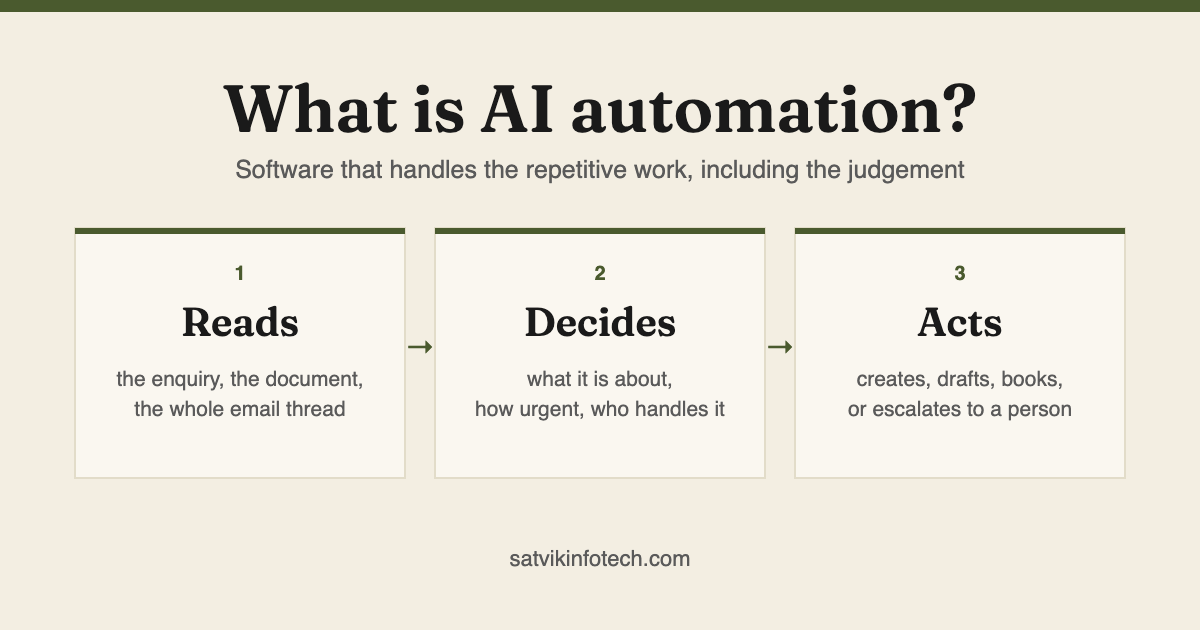
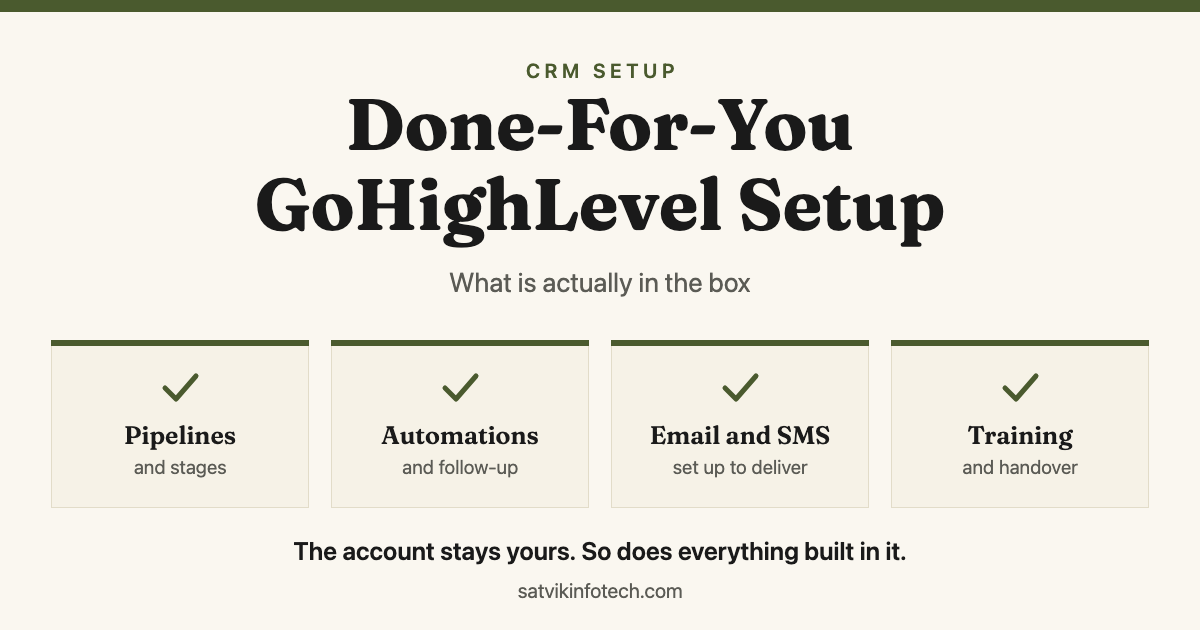
Most of that is ordinary workflow automation. The one step that genuinely benefits from a model is the reading and sorting, which is where AI automation earns its place. On GoHighLevel the whole chain is part of the build, which is set out in what a done-for-you setup includes.
What the clock is actually measuring
Almost every team that measures response time at all measures the wrong thing, and the wrong thing always flatters them. Three definitions are in common use, and only one of them is the number a buyer experiences.
The clock starts when the enquiry is submitted, not when somebody opens the inbox and sees it. An enquiry that lands at 19:40 and gets an answer at 09:05 the next morning took thirteen and a half hours, not the four minutes it took to type. Counting from first sight is the most common way a slow process reports itself as fast.
The second trap is the average. One enquiry answered in two minutes and one answered in two days average out to about a day, which describes neither of them. Use the median for the typical case and look at the slowest tenth on its own, because the tail is where the lost work actually sits.
The third is what counts as a reply at all. An acknowledgement that confirms receipt and says nothing else is not a response, even though every reporting tool will record it as one and stop the clock. If the automation exists to make that number look better, it is measuring itself.
Five minutes is a coverage problem, not an effort problem
This is the part that gets misdiagnosed. A team that replies in four minutes every time it is at its desk still has a slow median, and no amount of trying harder moves it, because the limit is not effort.
The arithmetic is blunt. Nine to five, Monday to Friday, is 40 hours out of the 168 in a week, so a team that is genuinely excellent inside its own office hours is simply absent for roughly three quarters of the week. Every enquiry that arrives in the other 128 hours waits, however good the people are.
It gets narrower again when the buyer is somewhere else. We work with clients across the US, Canada, the UK, the EU, Australia, New Zealand, Singapore and Japan, and a working day in one of those is the middle of the night in another. For a remote supplier the genuine overlap with any given buyer is a few hours, which means an exchange that needs two replies can cost two days.
| When it arrives | A people-only process | With a first reply automation |
|---|---|---|
| Weekday, at your desk | Fast, unless the person is in a meeting or on site | The same, and the notification arrives already sorted |
| Weekday evening | Seen the next morning, near the bottom of the overnight pile | Answered in minutes, with a specific time named for the call |
| Overnight | Eight to twelve hours, and longer if the morning is busy | Answered while they are still reading about suppliers |
| Saturday or Sunday | Monday, competing with everything else that arrived | Answered the same hour, and queued for Monday properly |
| Buyer in another timezone | Every exchange costs a day, because the replies never meet | The first exchange happens inside their working day |
| Holiday, illness, whole team away | Whenever somebody gets back to it | Unchanged, which is the point of building it once |
The automation is not competing with your best reply. It is competing with your average one, and your average is set by when enquiries happen to arrive rather than by how good anyone is at their job.
That is also why this is worth doing before most of the other candidates on the list. It is the first of the handovers covered in the order a small business should automate things in, and it is the one that runs at the hours nobody is paid to cover.
The trigger decides whether five minutes is even possible
Here is the plumbing detail that quietly decides the whole promise, and it is settled before a word of the message is written. There are two ways a form hands an enquiry to an automation tool, and only one of them is instant.
An instant trigger, usually a webhook, is pushed the moment the form is submitted. A polling trigger is the opposite: the automation tool asks the form on a schedule, and between two checks nothing at all happens, however urgent the enquiry is.
Which of the two you end up with is decided by how the form is wired in, not by the automation tool. If that form lives on WordPress, connecting WordPress to a CRM covers the three routes and which of them can fire instantly.
Zapier publishes the interval as a plan feature rather than burying it. Its pricing page lists polling time as 15 minutes on the free plan, 2 minutes on Professional and 1 minute on Team and Enterprise, checked at zapier.com/pricing on 11 September 2026.
So a five-minute promise built on a polling trigger on the free plan cannot be kept, no matter how well the message is written or how carefully the handover is designed. The delay is in the checking, and the only fixes are a webhook or a faster plan.
The cost objection people raise here does not apply, incidentally. Zapier states on the same page that checking for new data is not billed as a task and that only a completed action is, so frequent polling is a plan limit rather than a bill.
| How it is connected | How fast it can fire | What to do about it |
|---|---|---|
| Webhook or instant trigger | Seconds, on submission | Nothing. This is the one to ask for by name |
| Native trigger inside your CRM | Effectively immediate, since nothing leaves the system | Prefer it when the form and the CRM are one product |
| Polling trigger | Whatever the plan's interval is, and the clock starts at the next check | Move to a webhook, or price the plan that makes the promise true |
| Email parsing | Delivery time plus the parse, and neither is yours to control | Workable as a fallback, but it inherits somebody else's delay |
| Export, spreadsheet, import | As fast as the person who remembers to do it | Treat this as unautomated, because that is what it is |
Which tool sits behind the trigger matters less than people expect, and Zapier, Make and n8n compared is the place that argument belongs. What matters here is that you can name the trigger type, because a build nobody can describe is a build nobody can fix.
Where AI helps, and where a template is better
Use a model for the parts that need judgement: working out what someone is actually asking when they describe it in their own words, deciding whether this is a serious enquiry or a student doing research, and drafting a reply that responds to the specifics.
Use a plain template for anything that must be exact. Prices, availability, terms and promises should never be generated. A template with the right fields filled in is safer and reads no worse.
The line is simple: a model is good at understanding the question, and should be kept away from answers that commit you to something. What AI automation actually is covers where that boundary sits in more detail.
All of this assumes the enquiry arrived through a form. If you are still deciding which channel to put in front of it, an AI chatbot, live chat and a contact form compared is the question that comes first.
What goes wrong
- The bot that will not let go. Somebody asks for a person and gets another automated answer. Build the escape hatch first, and make it obvious.
- Two replies. The automation sends one, then a salesperson sends another an hour later saying the same thing. Whoever is notified needs to see what was already said.
- Out of hours confusion. A reply at 2am promising a call "shortly" sets an expectation you will not meet. Say when you will actually call.
- Silent failure. The worst version is a workflow that stopped last Tuesday and told nobody, which means every enquiry since went unanswered. This is the argument for monitored automations, and for the absence alerts described in automation mistakes that quietly lose you leads.
- A form nobody can finish on a phone. The fastest reply cannot answer an enquiry that was never sent. Try your own form on your own phone first, for the reasons in why responsive design matters to a business.
- Nobody owns the follow-up. The automation gets the conversation started, then it stops because no human was assigned. Decide that before building.
How to check your own first-response time
You can settle this in an afternoon, and it is worth doing before deciding whether any of the above is a problem you actually have. The answer is usually worse than the team expects and better than the worst case they fear.
- Take the last thirty enquiries, not the last week. A week is too short to contain a bank holiday, a busy Tuesday and a quiet one, and thirty is enough to have a median worth reading.
- Record two timestamps for each: when it was submitted, and when the first outbound message that says something went out. Not when it was opened, and not when an acknowledgement fired.
- Report the median and the slowest three separately. The median is your normal service. The slowest three are the ones that describe what happens on your worst day, which is the day a buyer will eventually land on.
- Count how many of the thirty arrived outside your working hours. That fraction is the ceiling on what effort alone can ever fix, and it is the number that decides whether this is worth building.
- Send yourself a test enquiry at 21:00 on a Saturday. Everything above is a reconstruction. This is the thing itself, and the reply you get is the one a buyer gets.
If the exercise turns up workflows that have quietly stopped rather than a process that is merely slow, that is a different problem with a different fix, and who fixes your automations when they break is the question to answer next. If it turns up a tool that cannot hold what you need between steps, the signs you have outgrown Zapier covers that line.
What it costs
This is one of the cheaper things to build, because the chain is short and the tools are ones you probably already pay for. If your CRM is GoHighLevel, a good deal of it exists already, and if you are still on HubSpot, what actually moves in the migration is the thing to read before you plan it.
Most of the cost is not technical. It is the hour spent deciding what the reply should say, who it comes from, and who picks it up afterwards, and that hour is what separates the version that works from the version that annoys people.
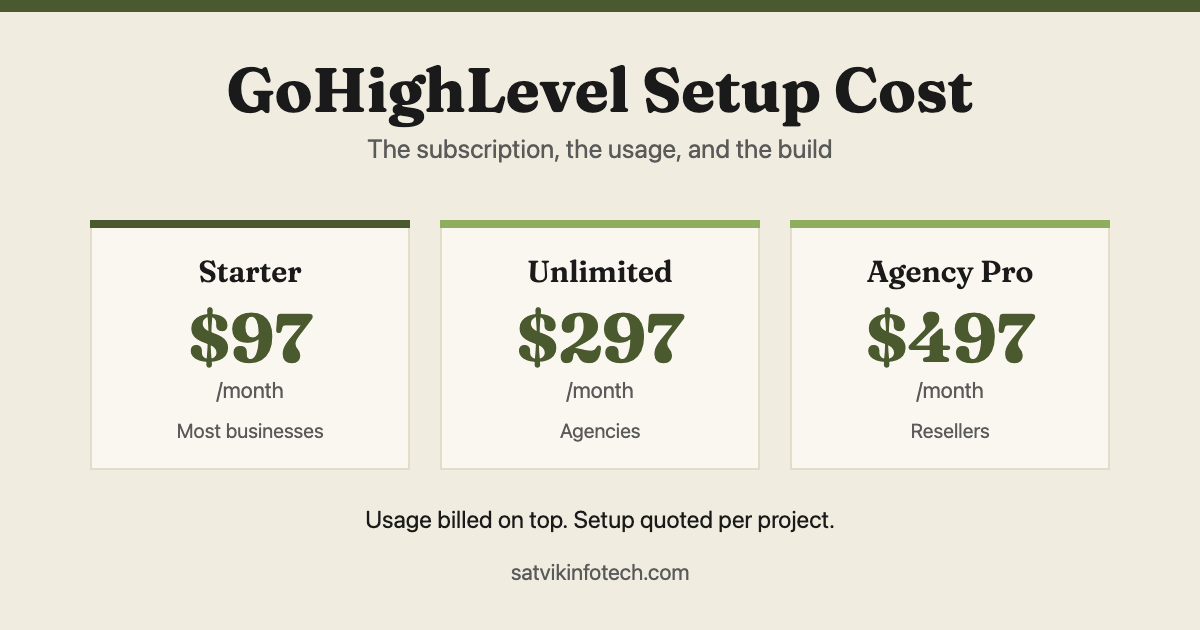
We quote per project after a free call. What AI automation costs breaks the whole question into its three bills, and if the CRM underneath is not settled, GoHighLevel and HubSpot compared is the cheaper question to answer first. More timelines and pricing sit on the answers page.
Common questions
Will an instant reply not look automated?
It will if you write it badly. A message that says "we have received your enquiry" announces a machine. One that answers their actual question, names a real person and offers a specific next step reads as attentive, and most people never wonder how it was sent.
What about enquiries that arrive at 2am?
That is the case that makes this worth building. Somebody researching suppliers at midnight gets a useful answer immediately instead of waiting nine hours, and by morning you are the one they have already spoken to.
Should the AI answer everything?
No. It should answer the routine questions completely, and hand over the moment something needs judgement, a price, or a promise. The handover is the part worth designing carefully, because a bot that will not let go is worse than no bot.
What if we get the reply wrong?
Then you correct it, the same as any team member. In practice the risk is smaller than it sounds because the first reply is acknowledgement and orientation, not a quote. Nothing binding should be automated.
What do we need for this to work?
Somewhere the enquiry lands that has an API, which in practice means a CRM or a form tool, and a decision about who owns the follow-up. Most of the setup time goes on agreeing what the reply should say rather than on connecting anything.
How do we find out how fast we reply now?
Export the last thirty enquiries and record two timestamps for each: when the form was submitted, and when the first outbound message with real content went out. Report the median rather than the average, look at the slowest three on their own, and count how many arrived outside your working hours. Then send yourself a test enquiry at nine on a Saturday evening, because that is the only measurement nobody can argue with.
Is five minutes a real threshold or just a round number?
It is a convention, and we do not republish the response-time figures that get quoted for it, because most are vendor-collected and they move. The durable finding underneath is about order rather than minutes: the supplier who answers first frames the comparison. Five minutes is simply short enough that being first is close to guaranteed, which is why it is the target worth building for.
If the enquiries are already arriving and the problem is what happens next, CRM setup and management is where that gets fixed properly. Answering fast is the first of seven handovers worth automating, and the full order covers everything that comes after it.