What does GoHighLevel actually cost?
The question hides two separate bills. There is what GoHighLevel charges you every month, and there is the one-off cost of somebody configuring it so it earns that money back.
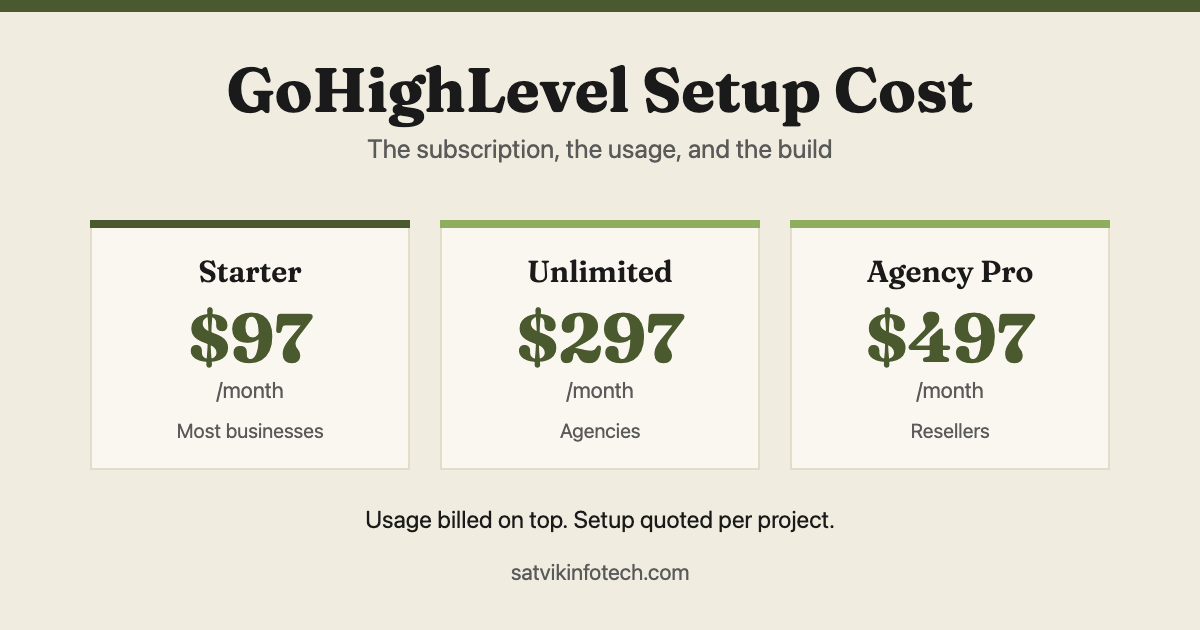
- The software is $97, $297 or $497 a month, or ten months' price if you pay annually. Almost every ordinary business wants the $97 plan.
- Usage is extra. Texts, emails and calls are metered on top and billed from a wallet, which is the cost people are not warned about.
- Judge it on the net figure. GoHighLevel is built to replace several subscriptions you already pay for, so the number that matters is what your monthly software bill looks like afterwards, not the $97 on its own.
- Setup is quoted per project, because a single pipeline and a clean contact list is a different job from migrating five years of messy data.
- The cheapest setup is rarely the cheapest outcome. The parts that get skipped are the ones that quietly stop your email reaching anyone.
The subscription, straight from the source
GoHighLevel publishes its pricing openly, which is more than several competitors manage. These are the plans as listed on 27 August 2026, and they include a 14-day free trial on any tier.
One detail the plan names hide: unlimited contacts and unlimited users come with every tier, including the $97 one. You are not being charged for growth in the way most CRMs charge for it, which matters when you compare the sticker prices.
| Plan | Monthly | Annual | What the extra buys |
|---|---|---|---|
| Starter | $97 | $970 | Three sub-accounts, unlimited contacts and users, all core features. |
| Unlimited | $297 | $2,970 | Unlimited sub-accounts, rebilling of phone and email at no markup, basic API access. |
| Agency Pro | $497 | $4,970 | SaaS mode, for agencies reselling the platform under their own brand. |
The plan names are the confusing part, and they are worth decoding before you overspend. A sub-account is a separate workspace for a separate business, so the whole ladder is priced around how many clients an agency is managing.
If you are one company running your own sales process, Starter is the plan. The upgrades sell agency capacity, not better software for you, and paying $297 for unlimited sub-accounts you will never open is the most common way to waste money here.
The costs on top that nobody mentions
This is the part that catches people out, and it is not hidden so much as unmentioned by everyone selling you the platform.
Text messages, emails and phone minutes are metered separately. You top up a wallet and usage draws it down, with rates varying by country and by message type. The subscription buys the software, not the sending.
For a business doing appointment reminders and SMS follow-up at volume, that usage line can end up larger than the $97. It is still usually cheaper than the separate SMS tool it replaces, but it belongs in the budget from the start rather than as a surprise in month two.
Two more that get missed. US SMS requires A2P registration, a compliance step with its own fee and a waiting period. And premium AI features inside the platform are generally billed on usage rather than included: GoHighLevel keeps a separate AI usage price list from its general usage rates.
What you can stop paying for
Every comparison of GoHighLevel treats the $97 as a new cost. For most businesses it is partly a swap, and working out the net figure is the only way to know whether the move is worth making.
GoHighLevel's own pricing page names the categories it expects to replace: CRM, funnel builder, email marketing, appointment scheduling, SMS marketing and review management, checked at source on 27 August 2026. That is the vendor's claim rather than ours, so it is worth testing against your actual card statement.
Here is how that claim holds up in practice, based on what we see when we migrate a small service business.
| What you are paying for now | Replaced by GoHighLevel? | In practice |
|---|---|---|
| Standalone CRM | Yes | The clean swap. This is the one that actually gets cancelled, once the data is across and the team has stopped opening the old tab. |
| Appointment scheduler | Yes | Usually cancelled. The built-in calendar is good enough for most booking, and having it inside the CRM is the point. |
| Email marketing tool | Mostly | Cancelled for follow-up sequences. Businesses sending large, design-heavy newsletters often keep the specialist tool and use GoHighLevel for pipeline email only. |
| SMS tool | Yes, but | The subscription goes, the sending cost does not. It moves to the metered wallet described above, so this is a line moved rather than removed. |
| Funnel or landing page builder | Yes | Cancelled, if your pages are campaign landing pages. Your main website is a separate question and usually stays where it is. |
| Review request tool | Yes | Cancelled, and often the easiest win, because most businesses were paying for this and barely using it. |
| Accounting, payroll, your website | No | Untouched. If a proposal implies GoHighLevel replaces your books, that is a reason to ask more questions. Connecting them is workflow automation, not CRM setup. |
The arithmetic is worth doing before you speak to anyone. Add up the monthly cost of the tools in the rows marked yes, subtract $97, then add your realistic SMS and email usage back on.
If that lands near zero, GoHighLevel is close to free and the only real question is the one-off setup. If it lands well above the $97, the platform is paying you to consolidate. If it lands well below, you are a business that does not use enough of the suite to justify it, and the honest answer is in the section on when it is not worth it.
Monthly or annual?
Paying annually costs ten months instead of twelve, which is a genuine 17 percent saving and the reason most people take it. The part worth thinking about is what you give up to get it.
GoHighLevel is month to month with no long-term contract, and you can upgrade, downgrade or cancel from the dashboard, as its pricing page states and we confirmed on 27 August 2026. Paying for the year converts that into a twelve-month commitment on a platform you have not yet lived with.
Our advice is to stay monthly through the setup and the first full quarter of real use, then switch to annual once you know the thing is embedded. Two months of saving is not worth prepaying a year for a system you might abandon in week six, and the trial is 14 days, which is long enough to click around and nowhere near long enough to know.
What the setup itself costs
We quote per project after a free call, and we would rather do that than publish a number that turns out to be wrong for you. The honest reason is that two businesses on the same plan can need very different amounts of work.
What we can do is tell you exactly what moves the number, so you can judge roughly where you sit before speaking to anyone, including us.
| Driver | Cheap end | Expensive end |
|---|---|---|
| Data migration | A clean spreadsheet, or starting fresh | Years of duplicated contacts across two old systems, needing reconciliation before import |
| Pipelines and automations | One pipeline, one follow-up sequence | Several services with different stages, routing rules and conditions |
| Integrations | Nothing outside GoHighLevel | Accounting, a store, a booking system and a custom app all kept in step |
| Phone and SMS | No texting | US A2P registration, number provisioning, opt-out handling |
| Email deliverability | Low volume from an existing domain | A fresh domain needing SPF, DKIM, DMARC and a warm-up period |
| Training | One owner who will happily click around | A team of ten who need it to work on day one |
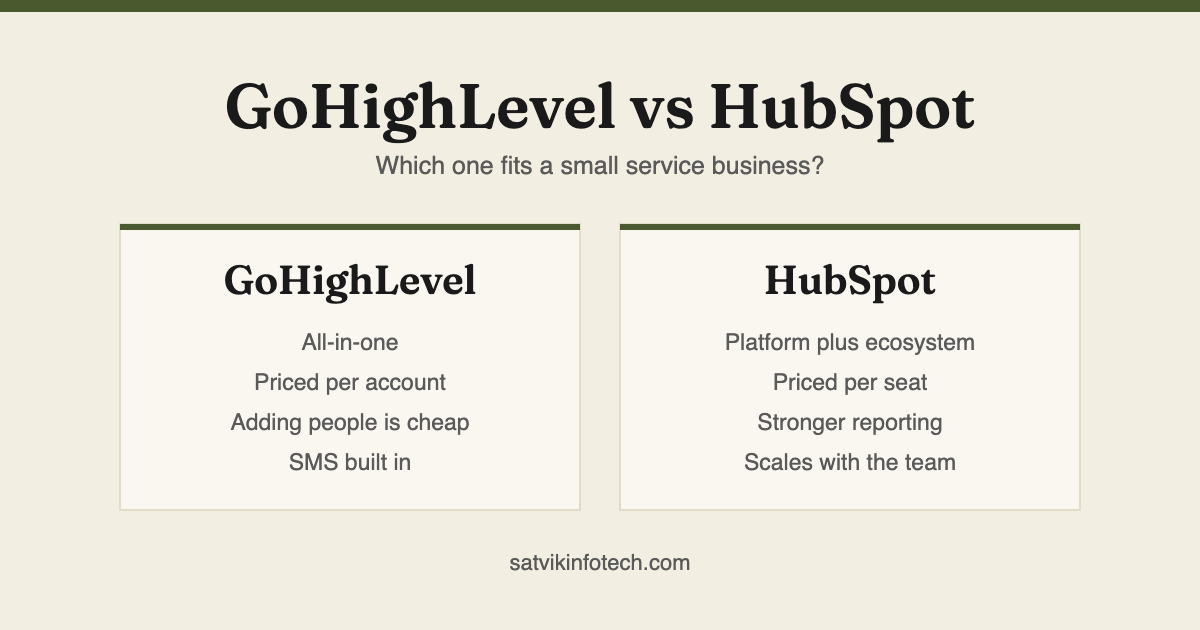
If your CRM decision is not settled yet, read GoHighLevel and HubSpot compared first. Choosing the platform changes what the setup work even is, so it is the cheaper question to answer.
What a cheap setup usually leaves out
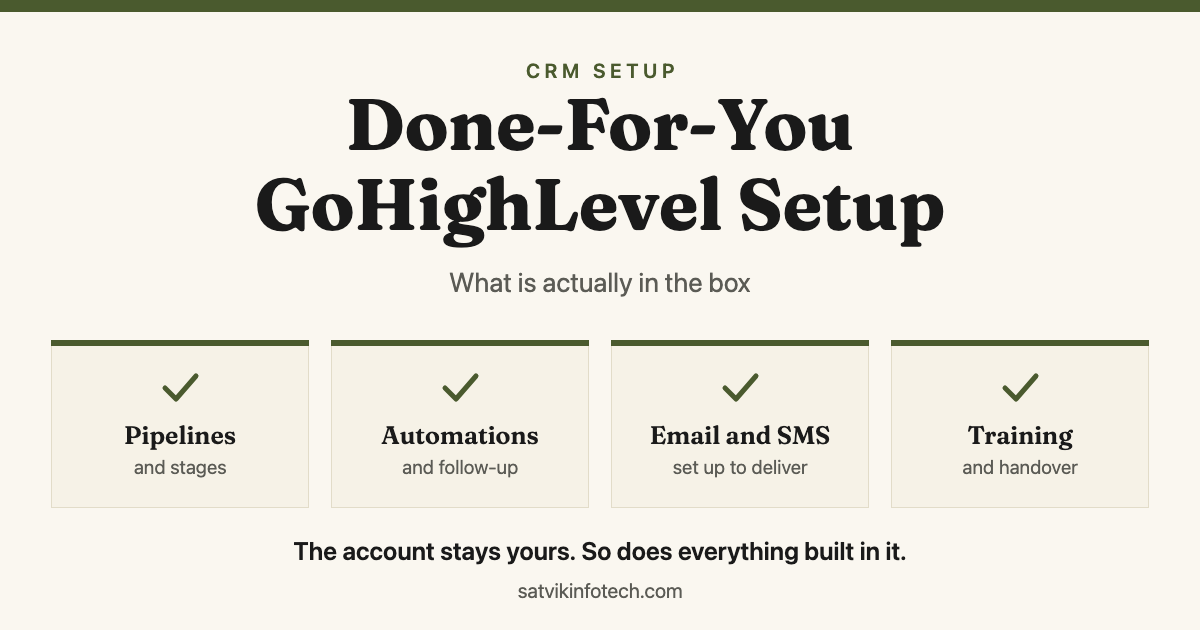
You can find someone to configure GoHighLevel for very little. The work that gets skipped at that price is consistent, and it is always the invisible half. The other side of the same question, what a done-for-you build actually includes, sets out the eight areas a complete setup covers.
- Email authentication. Without SPF, DKIM and DMARC set up properly, your carefully written sequences land in spam and you conclude the platform does not work.
- A2P registration. Skipped or done wrong, US texts silently fail to deliver. Nothing errors, the messages simply never arrive.
- Deduplication before import. Dumping two contact lists in creates duplicate people, which then get two of every follow-up.
- Testing with real edge cases. What happens when someone books and cancels, or replies STOP, or fills in the form twice.
- Handover. A system nobody on your team can change is a system you will pay someone else to change forever.
None of that is exotic. It is the difference between a CRM that works and one that looks like it works, and it is why we treat ongoing maintenance as part of the job rather than an upsell.
When GoHighLevel is not worth it
We recommend it first for most small service businesses, and we should say plainly where it is the wrong answer.
If your current CRM works and your team knows it, moving is disruptive for little gain, and what a HubSpot to GoHighLevel migration actually involves sets out why the rebuild costs more than the data. If you need deep reporting across a large sales team, a heavier platform fits better. And if you only need two tools to talk to each other, that is a job for workflow automation, not a new CRM.
The comparison we published on Zapier, Make and n8n covers that last case, and the same honesty applies here: the cheapest fix for many businesses is connecting what they already own.
GoHighLevel cost questions, answered
Is the GoHighLevel subscription all we pay?
No, and this is the most common surprise. The plan fee covers the software, but text messages, emails and phone minutes are metered separately and billed from a wallet you top up. For a business sending a lot of SMS, that usage line can end up larger than the subscription itself.
Is it cheaper than the tools we use now?
Often, but you have to work it out rather than assume it. GoHighLevel is designed to replace a CRM, a scheduler, an email tool, an SMS tool, a funnel builder and a review tool, so compare the $97 against the total of whichever of those you actually pay for today. What it does not replace is your accounting, your payroll or your website, and any proposal suggesting otherwise is worth questioning.
Which plan does a normal business need?
Starter, in almost every case. The higher plans exist to give agencies unlimited sub-accounts and resale features, which is why they are named the way they are. If you are one business running your own sales process, the extra sub-accounts buy you nothing.
Can we set it up ourselves?
Yes, and some businesses should. GoHighLevel is not hard to log into and the trial is genuinely usable. What takes the time is the parts that are invisible until they break: email authentication, SMS registration, pipeline design and migrating old data without duplicating it.
How long does a setup take?
A focused build is usually days rather than weeks. The two things that stretch it are data migration, which depends entirely on how tidy the old system was, and US SMS registration, which has a waiting period nobody can shorten.
What happens if we want to leave later?
Your contacts and their history export cleanly. What does not come with you is everything built inside the platform: workflows, funnels, forms and templates all have to be rebuilt elsewhere. That is true of every CRM, and it is worth knowing before you commit rather than after.
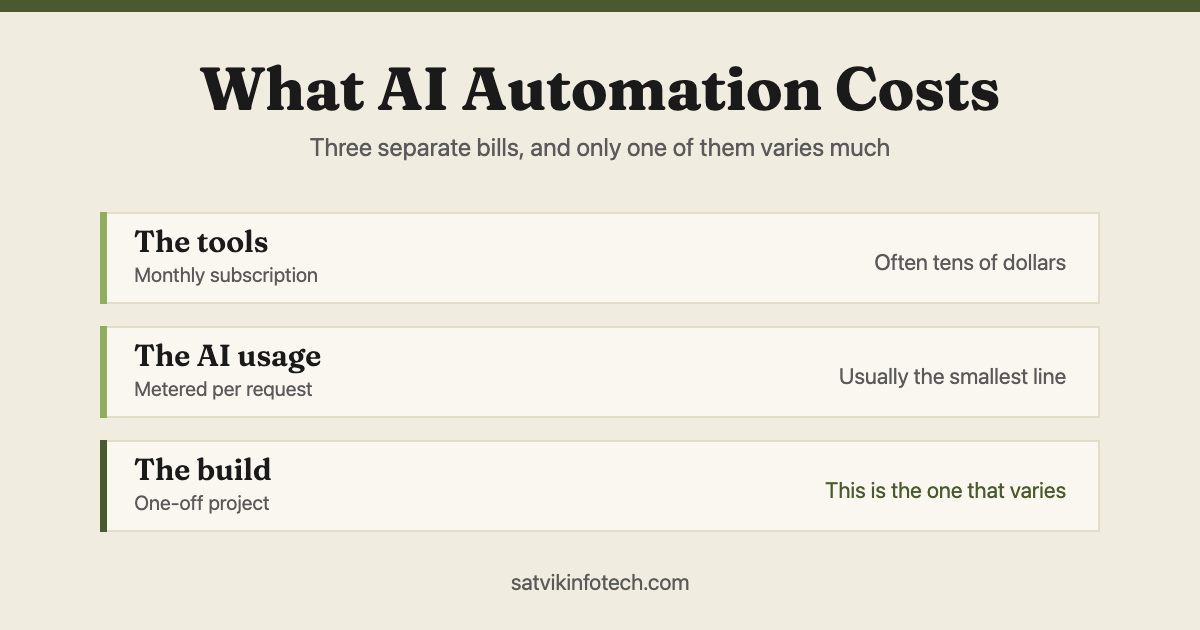
If the question is broader than the CRM, what AI automation costs splits the whole thing into three bills. More pricing and timeline answers are on our answers page, and CRM setup and management explains what we actually do in a build. If invoicing is the part eating your week, automating invoicing and accounting covers connecting the CRM to your books.