What does AI automation actually cost?
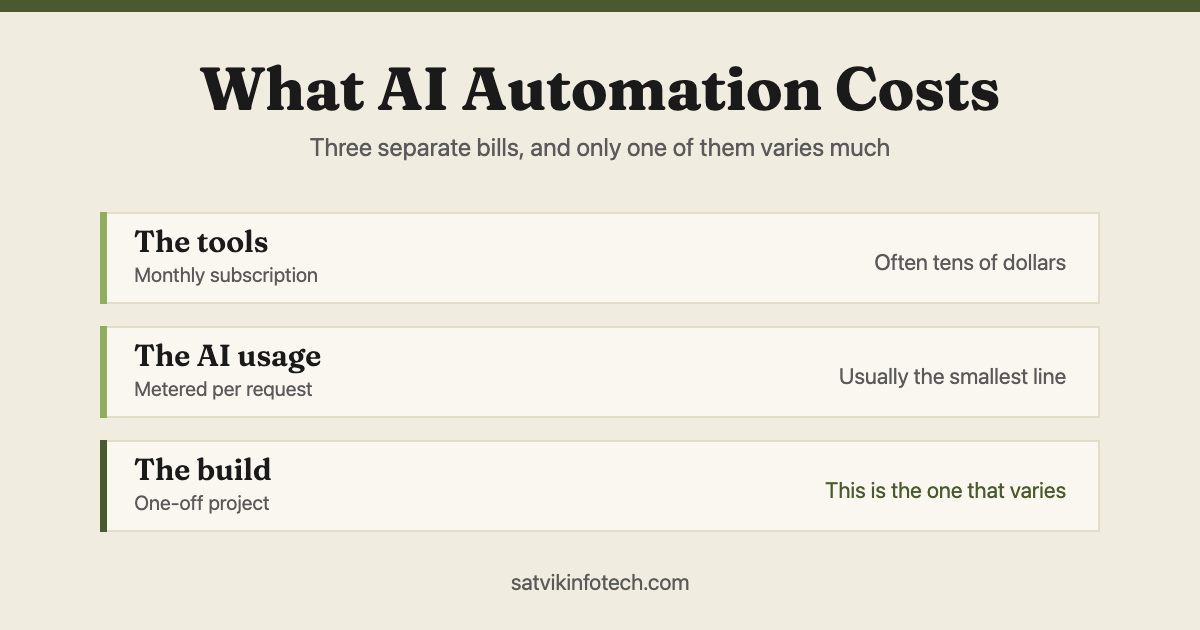
The question hides three separate bills, and conflating them is why quotes people receive seem to vary wildly. Separate them and the number becomes predictable.
- The tools are a monthly subscription you pay the vendors directly. Often tens of dollars, not hundreds.
- The AI usage is metered per request, and it is almost always the smallest of the three. This surprises people.
- The build is a one-off project cost, and it is the part that actually varies. It depends on your data and your systems, not on the word AI.
- Maintenance is the fourth line everyone forgets, and the one that decides whether the other three keep earning.
The three bills, side by side
Here is the shape of it before any numbers, because the shape is what people get wrong. The biggest line is the one-off, not the recurring.
| Bill | Shape | Who you pay | What changes it |
|---|---|---|---|
| Tools | Monthly subscription | Zapier, Make, your CRM | Volume. More runs means a higher tier. |
| AI usage | Metered per request | The model provider | How much text goes in and out, and how often. |
| The build | One-off project | Us, or whoever builds it | Data tidiness, number of systems, how custom the logic is. |
| Maintenance | Monthly, optional | Us, or nobody | How much it costs you when it breaks unnoticed. |
The tools, with real numbers
These are published prices you can check yourself, which is the point. Anyone quoting you for automation should be able to show the tool cost separately from their own fee.
Zapier starts free, with 100 tasks a month, which is enough to prove one small workflow works. Paid plans start from $19.99 a month, checked on their pricing page on 19 August 2026.
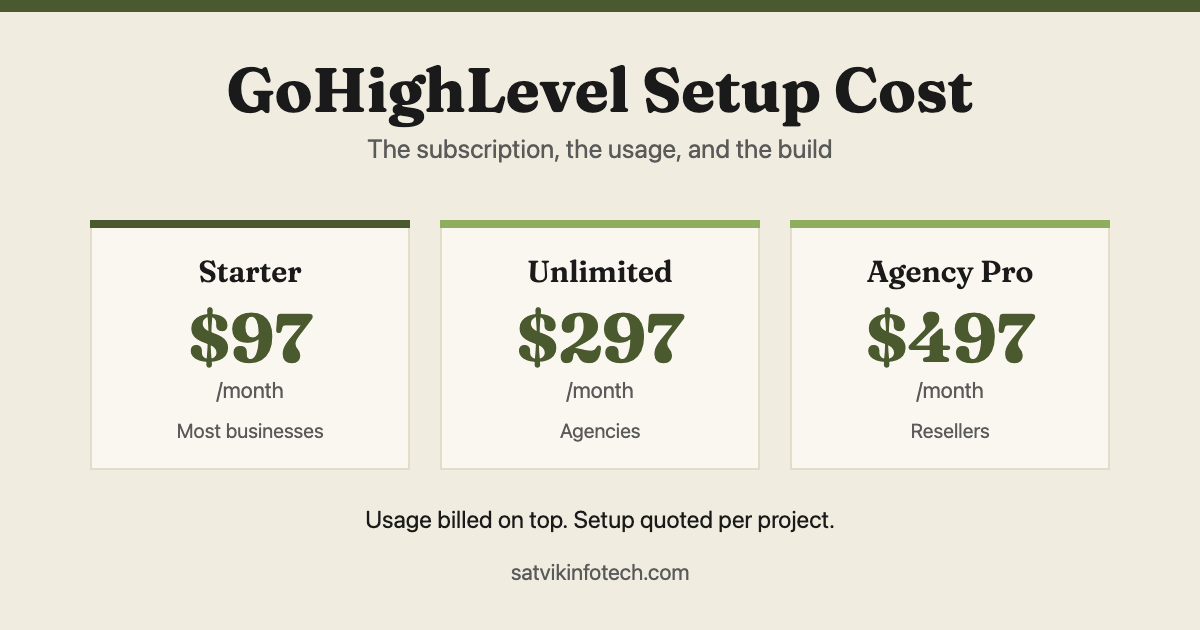
GoHighLevel, if a CRM is part of it, is $97 a month on the plan an ordinary business needs. We broke that down separately in what a GoHighLevel setup costs, including the usage charges that sit on top.
If per-task pricing is the thing worrying you, Zapier, Make and n8n compared works through where each stops making sense, including self-hosting n8n to cut the subscription entirely.
The AI usage is the smallest line
This is the part that surprises people, so it is worth stating plainly: the AI is rarely what makes an automation expensive.
Model providers bill per token, which means cost scales with how much text goes in and comes back. The jobs a business actually automates are short ones: read this enquiry and decide how urgent it is, draft a reply to this question, pull four fields out of this invoice.
Short jobs on the smaller models cost very little per run, and the small models are genuinely good enough for classification and drafting. Providers publish current rates and change them often, so check the live figure rather than trusting any article, including this one.
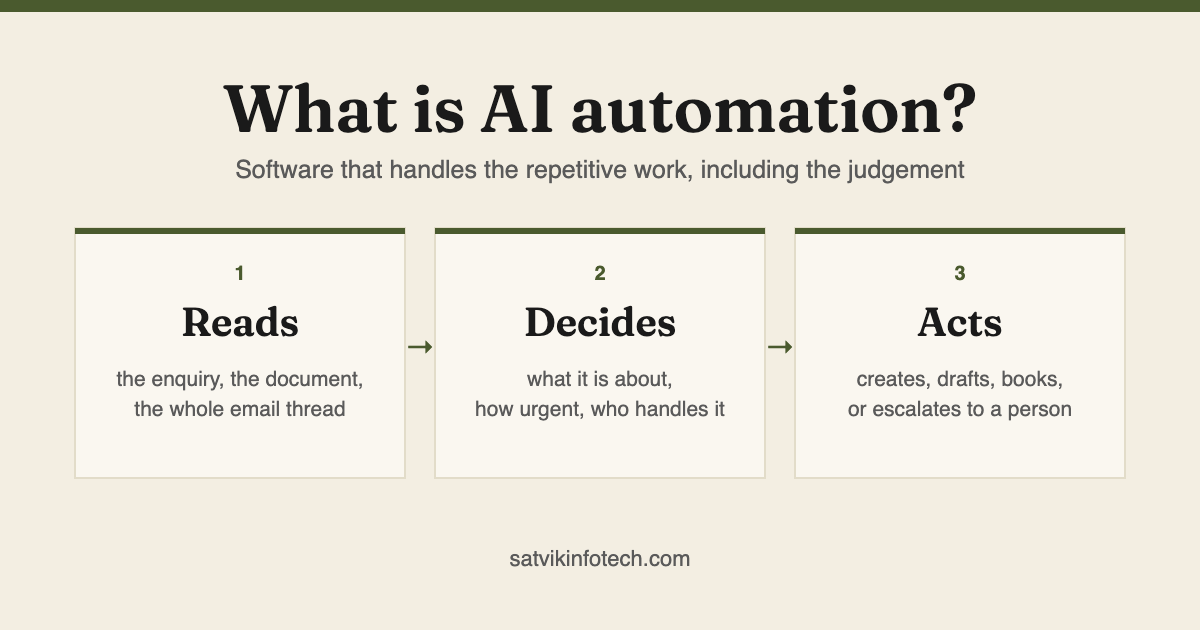
Where AI cost does become real is long documents, high volume, or asking a large model to do something a rule would have handled. What AI automation actually is covers that line, because using judgement where a rule would do is the most common way to overspend.
A website chatbot is the clearest example of a short, cheap job, since most conversations are a handful of exchanges. An AI chatbot, live chat and a contact form compared sets out what one has to be able to do before it is worth running at all.
The shape changes once the model is the product rather than one step in it, because then a share of your running cost scales with usage. What AI-first app development means covers what else moves when that is the case.
The build, and what moves it
We quote per project after a free call, and we would rather do that than publish a figure that turns out not to apply to you. What we can do is show what moves the number, so you can place yourself before speaking to anybody.
| Driver | Cheap end | Expensive end |
|---|---|---|
| How many systems | One trigger, one destination | A CRM, a store, an accounting package and a booking tool kept in step |
| State of the data | Clean, or starting fresh | Duplicated contacts across two old systems, needing reconciliation first |
| How custom the logic is | A ready-made connector covers it | Rules no connector supports, needing direct API work |
| What happens on failure | A human notices next morning | Silent failure costs real money, so it needs monitoring and retries |
| Who has to use it | One owner who will happily click around | A team who need training and documentation on day one |
The arithmetic that actually decides it
Rather than guess at our fee, work out what the problem is costing you now. That number tells you what the work is worth, and it is a better guide than any quote.
Take the task you want automated. Multiply the hours a week it consumes by the hourly cost of the person doing it, then by 52. That annual figure is what you are already paying, every year, for something nobody enjoys doing.
Then add the part that does not appear on a payroll line: the enquiries answered too late, the follow-ups nobody sent, the invoice raised a fortnight after the work finished. For most businesses that second number is larger than the first.
If the annual cost of the problem is comfortably more than a one-off build plus a modest monthly subscription, the answer is yes. If it is close, automate one small thing first and measure it rather than committing. Choosing which small thing is the point of the seven tasks worth automating first.
The line everyone forgets
Automations break. Not often, but reliably, because the tools around them change: an API updates, a plan changes, somebody renames a field in the CRM.
The failure that costs money is the quiet one. A workflow that stops on a Tuesday and is noticed the following month has silently dropped every enquiry in between, and no error message ever appeared.
That is the whole argument for ongoing maintenance, and why we treat it as part of the job rather than an upsell. The same logic applies to the money side, which we covered in automating invoicing and accounting.
Cost questions, answered
Is AI automation more expensive than ordinary automation?
Usually only slightly, and less than people expect. The connectors, the CRM and the build cost the same either way, and the AI itself is metered per request rather than sold as a separate subscription. The bigger cost difference comes from complexity, not from the word AI.
Can we start small?
Yes, and you should. One workflow that removes a real bottleneck tells you more about whether this pays than any proposal will, and it is cheap enough to abandon if the answer is no. Everything we build is designed so the first piece works on its own.
What is the ongoing cost after launch?
The tool subscriptions, the metered AI usage, and maintenance if you want someone watching it. The first two are predictable. The third is the one businesses skip and then pay for later, when something breaks quietly and nobody notices for a fortnight.
Do we pay you monthly or once?
The build is a project. Maintenance is monthly and optional, though we would rather you took it, because an automation nobody is watching is an automation that will eventually fail without telling you.
Why will you not publish a price list?
Because a number without your context would be wrong. Two businesses asking for the same thing can need very different amounts of work depending on how tidy their data is and how many systems are involved. We give a fixed figure after a free call rather than a range that turns out not to apply.
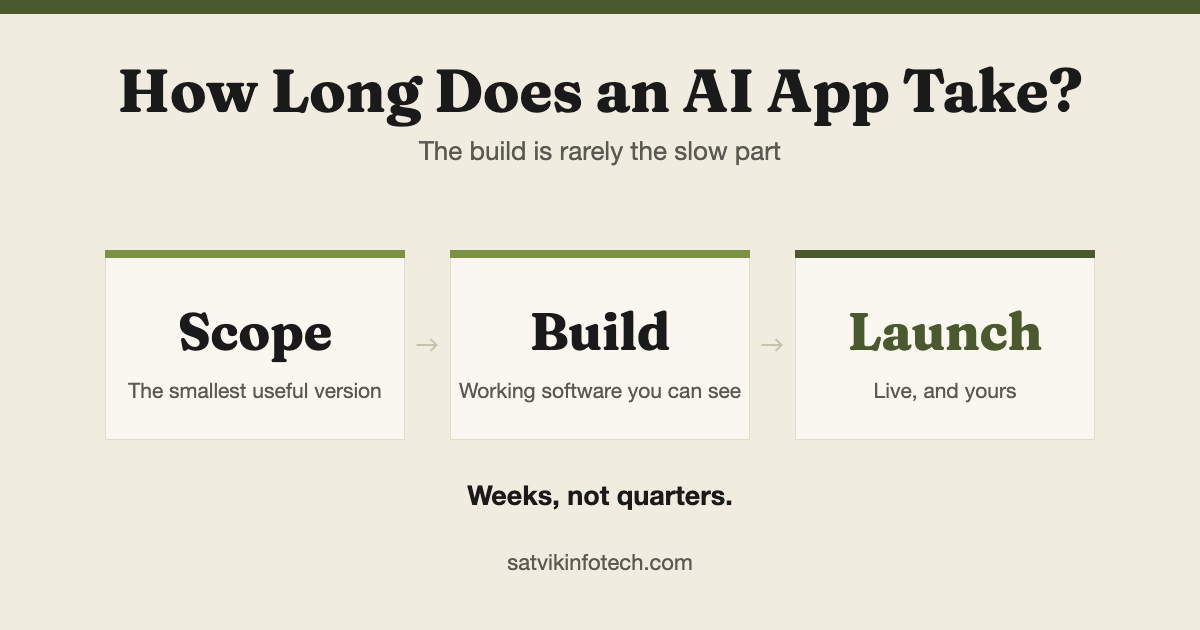
If you want a number for your situation, the fastest route is the free call: we look at the process, tell you what we would build first, and give you a fixed figure. More timeline and pricing answers sit on the answers page, and AI automation explains what a build actually includes. If the question is the calendar rather than the invoice, how long an AI app takes to build covers what actually moves a delivery date.