What is AI-first app development?
AI-first app development means designing the product around what a model can do, instead of building a conventional application and adding AI features to it afterwards. The difference is not how much AI ends up in the product. It is whether the central job the app does depends on a model's judgement, and whether the build is honest about that judgement being wrong some of the time.
- The core action belongs to the model, not to a form. The user describes, uploads or asks, and the product produces the thing they came for, rather than collecting fields that a rule then processes.
- Being wrong is a designed-for state. Review, correction and undo are part of the main screen from the first version, not an admin panel somebody builds later.
- The data model keeps inputs, not just results. What was asked, what was sent to the model and what came back are stored, because without them you cannot tell a good week from a bad one.
- Done is measured as a rate. Acceptance is the proportion of real examples the product handles well, since a feature whose output varies cannot pass or fail a single test.
The same app, built both ways
Take a product that handles incoming customer requests for a service business. Both versions of it are real things people build, and both are sold with the same word on the homepage.
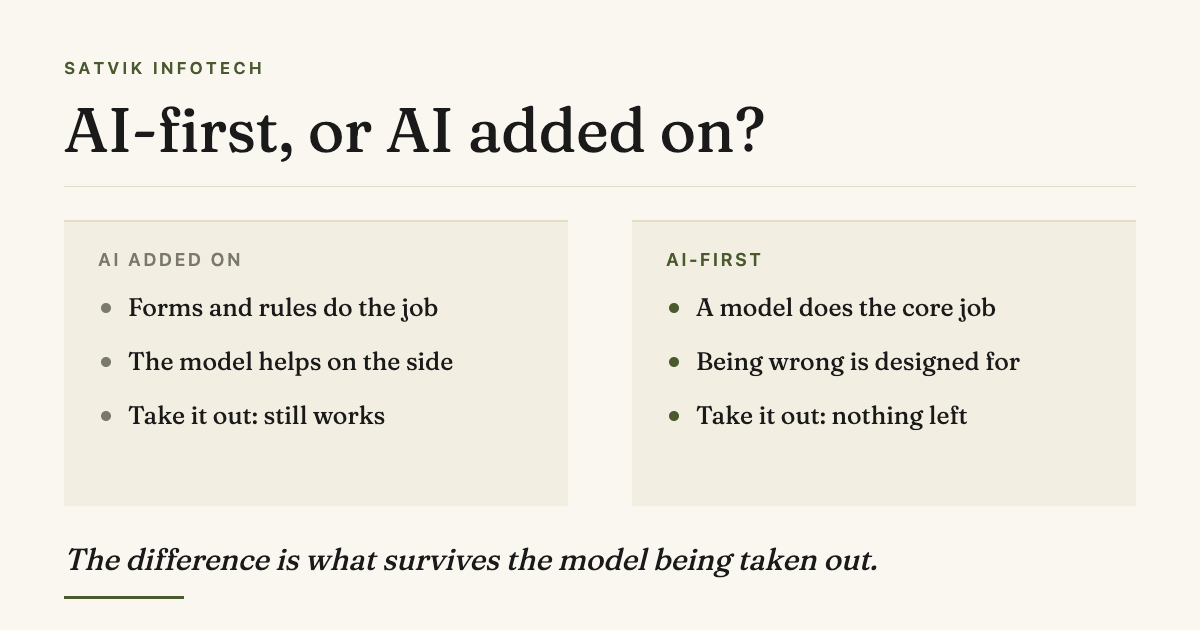
The bolt-on version is a conventional application. There is a form, a queue, a set of rules that route by category, and somewhere on the page a helpful assistant that can summarise a long request or draft a reply.
The AI-first version starts from the request itself. A model reads it, decides what it is, drafts the response, and the interface exists to show its working and let a person accept, edit or reject it.
| Decision | AI added on | AI-first |
|---|---|---|
| Where the model sits | Beside the work, as an optional helper | In the middle of the work, doing the central step |
| What the user does first | Fills in the fields the system needs | Says what they want in their own words |
| When the model is wrong | The user ignores it and carries on manually | The product must catch it, show it and make it correctable |
| What gets stored | The finished record | The request, the context sent, the answer and the correction |
| What "finished" means | The feature works or it does not | An agreed hit rate across a set of real examples |
| When models improve | The helper gets slightly better | The product's core capability moves, and the roadmap with it |
Neither column is the correct answer. The bolt-on build is often the right call, and it is cheaper, more predictable and easier to support.
What causes trouble is choosing one and building the other. A team that scopes a bolt-on and then puts a model in the critical path inherits every AI-first problem without having budgeted for any of them. Working out whether a supplier can tell the two apart is part of choosing an app development company.
The test: take the model out
There is a quick way to tell which one you are actually building, and it works before any code exists. Describe the product, then delete the AI from the description and read it again.
If what remains is a working product that is a bit more laborious to use, you are adding AI to a conventional application. That is a legitimate and often sensible thing to build, and it should be scoped, priced and tested as ordinary software with one extra feature.
If what remains is an empty shell, a form with nowhere for the answer to come from, then the product is AI-first. Everything downstream of that finding changes, which is the subject of the rest of this article.
The test is useful because the honest answer is often the first one. Plenty of products described in a pitch as AI-first turn out, under this test, to be a solid conventional app with a good assistant in it, and knowing that early is worth more than the label.
Three things it actually changes
When the model is in the critical path, three decisions move, and they are the ones that quietly set the shape of the whole build.
The data model changes because you have to store the reasoning, not only the result. A conventional app records that a request was categorised as billing; an AI-first one records what was asked, what context was supplied, what came back and whether a human changed it.
That extra record is not analytics for later. It is the only way to answer "is this getting better or worse", and adding it after launch means the first months of evidence are gone.
The interface changes because correction becomes a main-screen job. If a model writes the reply, the person using the product needs to see what it based that on and change it in one step, which is a different screen from one designed for typing a reply from scratch. It is also a screen no static mockup captures, which is the practical limit on what a design file can tell the code.
The definition of done changes because output that varies cannot pass a boolean test. Acceptance becomes a rate against a fixed set of real examples, which means somebody has to collect those examples and agree what a good answer looks like before the build is finished.
| Build decision | Conventional application | AI-first application |
|---|---|---|
| The data model | Stores the result | Stores the request, the context, the answer and the correction |
| The interface | Collects input, then displays output | Shows a draft with its basis, and makes editing it the fast path |
| Definition of done | The test passes | An agreed hit rate holds across real examples |
| Testing | Deterministic, run on every change | Deterministic around the model, sampled against examples through it |
| Running cost | Largely fixed, scales with users | Partly variable, scales with how much the product is used |
| What ships first | The smallest working feature | The smallest working feature, plus the way a human overrides it |
The last row is the one teams skip, and it is the expensive one. Shipping the model's output with no override means the first wrong answer in front of a customer is also the first time anybody thinks about what to do with one.
Most of it is still ordinary software
The phrase suggests a different kind of product from top to bottom. In practice, the model is a slice through the middle of an application that is otherwise built exactly like any other.
Accounts, permissions, billing, search, notifications, an audit trail, hosting, backups, accessibility and the data protection obligations that come with holding customer information are all unchanged. They are also, on most builds, the majority of the work.
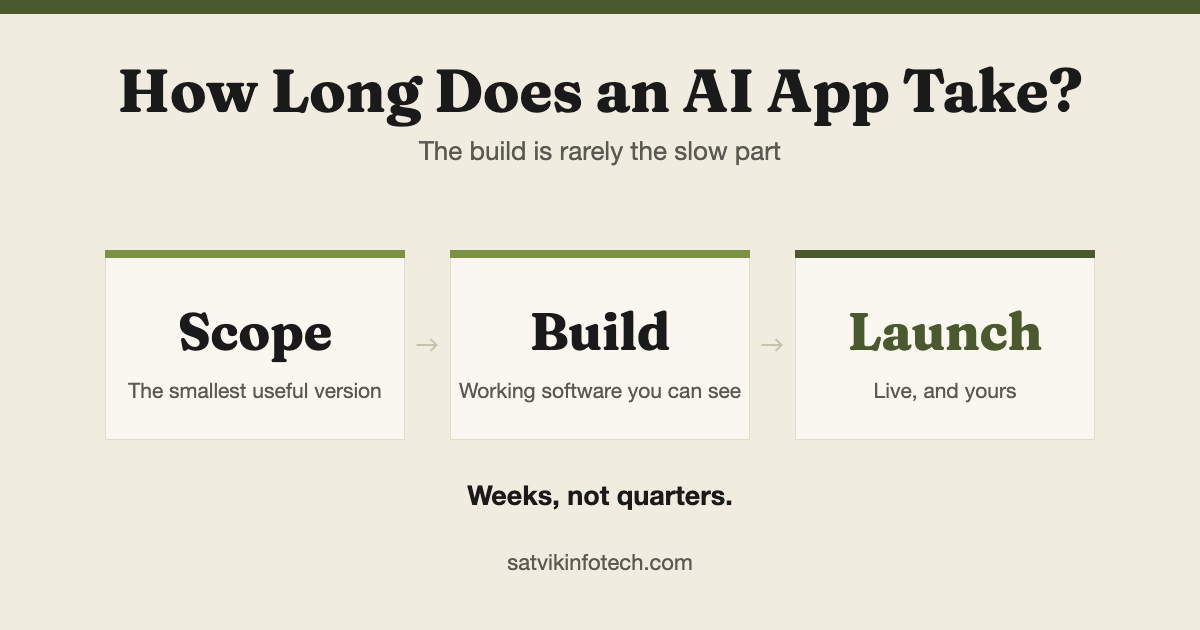
This is why an AI-first build is not automatically faster than a conventional one. The model can produce a convincing demo in an afternoon and then take weeks to make dependable, which is the pattern described in more detail in how long an AI app takes to build.
It is also why the same discipline applies afterwards. An AI-first product needs the same monitoring, updates and ownership as anything else we run, which is what ongoing maintenance covers, and a model provider changing something underneath you is one more reason for it.
When AI-first is the wrong call
Four situations make it a poor choice, and recognising one early saves a great deal of money.
- The task has a right answer a rule can compute. Tax bands, delivery charges, eligibility against fixed criteria: if the logic can be written down, write it down. A model is a slower, costlier and less predictable way of doing arithmetic.
- A wrong answer is expensive and nobody will check it. Where the output goes straight to a customer, a regulator or a payment, and no review step is realistic, the variability is a liability rather than a feature.
- You need a deterministic audit trail. Some obligations require showing exactly why a decision was made, and "the model judged it so" is not that, however well you log around it.
- Nobody can say what good looks like. If you cannot produce twenty real examples and agree on the right answer for each, you cannot tell whether the build is working, and you will be shipping on impressions.
The fourth is the one that stops most projects that should be stopped. Collecting those examples takes an afternoon, and doing it before anything is built is the cheapest test in this article.
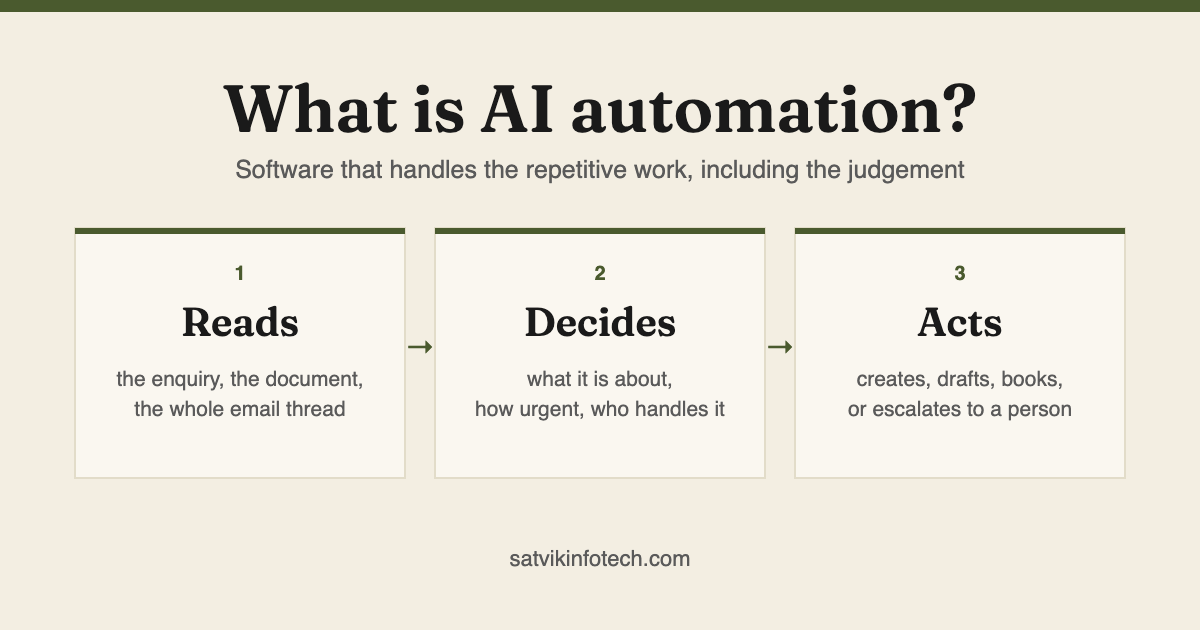
There is also a middle path worth naming. Where the goal is to take a repetitive process off people's hands rather than to build a product, the answer is usually not an application at all, and AI automation across the tools you already own is faster and cheaper than anything custom.
How we scope an AI-first build
This is the sequence we work through before writing anything, and it exists to make the awkward questions arrive early rather than at launch.
- Name the one judgement. Which single decision are you asking a model to make? If there are four, the build has four risks and should be sequenced, not started at once.
- Write down what wrong looks like. Describe a bad answer concretely, then say who sees it and what they can do about it in one click.
- Collect twenty real examples. Actual inputs, not invented ones, with an agreed good answer for each. This becomes the acceptance measure and it outlives the first build.
- Build the boring path first. Accounts, storage, permissions and the screen a person uses to correct the output. The model is added to a product that already works without it.
- Set the rate, not the promise. Agree the hit rate that makes the product useful, and design the review step so the remainder is survivable rather than pretending it will not happen.
- Decide what is logged on day one. Inputs, context, outputs and corrections, with a retention period, so month two can be compared against month one.
Step four is the one clients push back on, because the model is the exciting part and the accounts screen is not. It is also the step that turns a demo into something you can sell, and it is how our AI app development work is sequenced.
Where the product has to fit alongside a CRM and the tools a business already runs on, the integration work is its own decision, and both workflow automation and CRM setup and management usually sit next to a build like this rather than inside it.
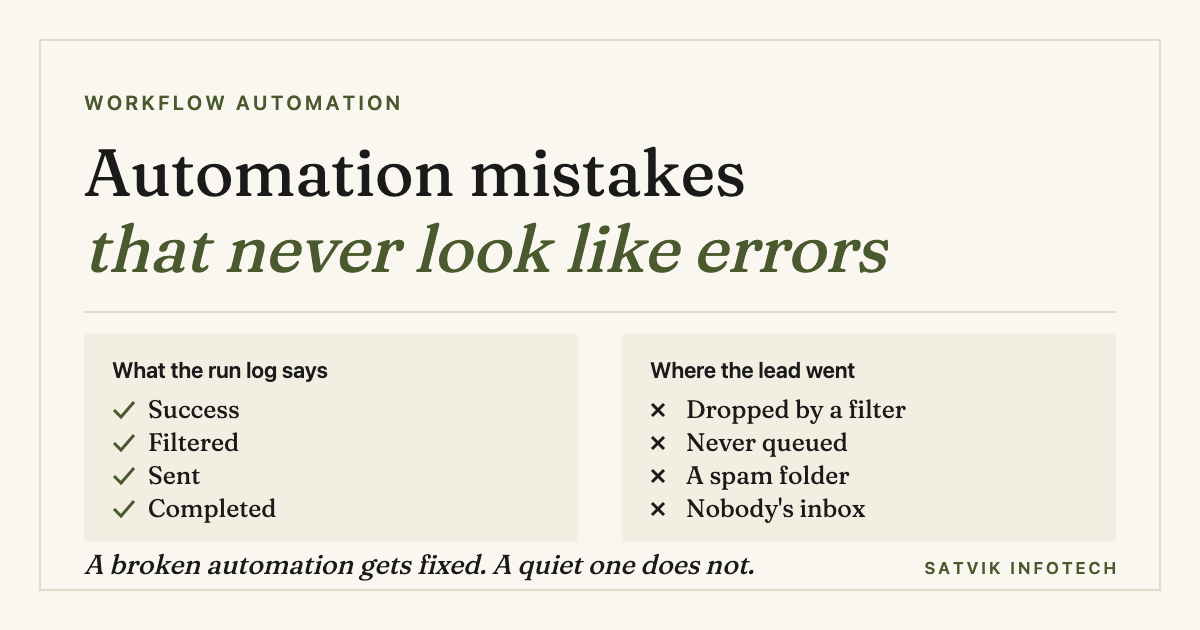
One habit carries over from the automation side and matters more here. Let the model read, classify, summarise and draft, and let a rule decide anything final, for the reason set out in the automation mistakes that quietly lose you leads: a wrong answer looks exactly like a right one in a log.
None of this settles how the product actually reaches a phone, which is a separate call: cross-platform against native apps covers what genuinely differs between iOS and Android and what that does to a shared codebase.
Common questions
What is the difference between AI-first and adding AI to an existing app?
Where the model sits in the job the product does. Adding AI gives an existing application an assistant beside the work: the forms, rules and screens still do the job, and the model helps with it. AI-first means the model performs the central step itself, so the rest of the product is built around checking and recording a judgement rather than around collecting input.
Does AI-first mean the app is built by AI?
No. AI-first describes the product rather than the process: it is about a model doing the core job for the user once the app is live. We do use AI tools while building, in the same way we use any other tool, but that is a separate question and it does not change what the finished application is.
Do I need my own data or a custom-trained model?
Usually not to start. Most AI-first products begin on a general-purpose model with your own context supplied at the moment of the request, which needs no training run and no dataset of your own. Training or fine-tuning is a later optimisation, worth doing once real usage shows where the general model is consistently weak.
How do you test something that answers differently every time?
By fixing a set of real examples and measuring a rate rather than a pass. You collect inputs the product will genuinely see, agree what a good answer looks like for each, and track the proportion the model gets right as the build changes. Everything around the model, which is most of the application, is still tested the ordinary deterministic way.
How much does an AI-first app cost to build and run?
Building it is quoted per project, because the scope is what sets the figure. Running it differs from ordinary software in shape: part of the cost scales with how much the product is used rather than sitting flat, because every model call is paid for. The model calls are often not the largest line, and ordinary hosting, storage and maintenance still are.
If the question behind this one is really about budget rather than architecture, what AI automation costs covers how we size the smaller version of this work, and the questions we ask before quoting anything are set out on our answers page.