The short answer
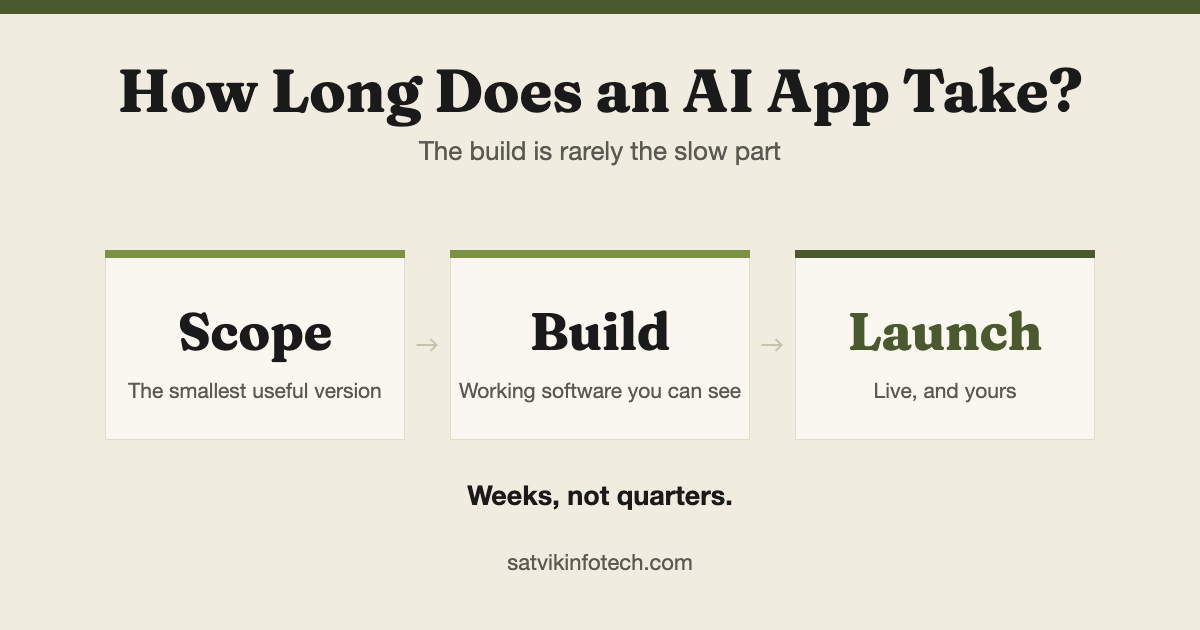
A first useful version is normally a matter of weeks rather than quarters. What decides where in that range you land is mostly not the engineering.
- Scope sets the floor. The smallest version that solves one real problem is the fastest thing anyone can build for you, and everything added to it moves the date.
- Decisions set the pace. A team that answers questions the same day finishes noticeably sooner than one that answers them next week, with the same developers doing the same work.
- Access sets the ceiling. If the app has to talk to your CRM, your accounting system or your document store, the build waits on credentials whether or not anyone is idle.
- The AI feature is rarely the long pole. Making a model do something impressive is quick. Making it dependable enough to put in front of customers is the part that takes time.
Why nobody can quote it up front
Anyone who gives you a timeline before scoping is guessing, and the reason is that the same sentence describes completely different products.
Take "an app that reads our documents". That could be one upload box that returns a summary, which is genuinely small. It could equally be a permissioned archive across five file formats, with audit logging because the documents are confidential and a review step because a wrong answer matters.
Both are honestly described by the same seven words. Only one of them is a few weeks of work. This is why our AI app development work starts by agreeing the smallest useful first version and pricing that, rather than quoting a range against a sentence.
Three kinds of AI build, three different clocks
"How long does it take to build an AI app" is really three questions, and they do not share an answer. Naming which one you are asking is the fastest way to get a useful estimate out of anybody.
| What you are building | What dominates the schedule | What people underestimate |
|---|---|---|
| An AI feature inside an app you already have | Getting the model reliable access to data that already exists, in a product that already has users | That real users are already there, so the wrong answer has an audience from day one |
| A custom AI application | Everything a conventional product needs, on top of the model work: accounts, permissions, an interface, billing | How much of it is ordinary software. The model is one component, not the product |
| An AI agent over your own systems | Access. Every system it touches needs credentials, permissions and a decision about what it may do unsupervised | That the smallest-looking build is the one most often held up by other people's approvals |
The middle row is the one usually meant by a custom AI application, and it is the longest of the three for a reason that has nothing to do with AI. Sign-in, permissions, an interface somebody can use without training and a way to take payment are all still required, and none of them gets shorter because a model is involved.
The third row is the one that surprises people. An agent working across your existing tools needs almost no new interface, which makes it look like the small job, and then it waits three weeks for access to the systems it was supposed to be working across. Where that shape is what you actually want, AI automation is usually the faster route to it than a product build.
The five stages, and what sets the length of each
A build runs in five stages. Knowing which of them is elastic tells you where a schedule will actually move.
| Stage | What sets its length | What makes it drag |
|---|---|---|
| Discovery | How clear you already are on the problem being solved | Internal disagreement about what the first version is for |
| Design | The number of distinct screens and flows | Review cycles with no single decision maker |
| MVP build | Feature count, and how many systems it integrates with | Waiting on credentials, or scope added mid-build |
| Launch | Where it is deployed and who needs training | Real content arriving late, or an unplanned security review |
| Iterate | Ongoing, driven by what real users do | Nothing. This stage is not meant to end |
The pattern in the right-hand column is worth noticing. Almost none of it is engineering difficulty, and almost all of it is coordination.
What actually sets the clock
After enough builds, the same three things turn out to explain most of the difference between a project that lands early and one that slips.
- Who can say yes. One named person who can settle a question in an afternoon is worth more to a schedule than an extra developer. Committees do not make software faster.
- Whether the integrations are real yet. "It needs to sync with our CRM" is a sentence, not an integration. Somebody has to grant API access, and in many companies that request sits in a queue. Getting that started on day one costs nothing and routinely saves a week.
- Whether the content exists. Apps stall waiting for the actual text, the actual product data and the actual policies. Placeholder content hides this until launch week, when it stops hiding.
All three sit on your side of the table. That sounds like bad news and is the opposite: they are the parts you can move without anyone's permission.
The AI part is fast to demo, slow to trust
There is a specific rhythm to building AI features that catches people out, and it is worth knowing before you set expectations internally.
The first working version arrives fast. A model summarising your documents or answering questions about your products can be demoed remarkably early, which makes the whole project feel nearly done when it is not.
Then comes the part that takes the time: deciding what happens on the occasions it is wrong. Who checks it, what the user sees when confidence is low, what gets logged, and where a human takes over. That work is invisible in a demo and is the entire difference between a prototype and something you would let a customer use.
Designing for that from the start, rather than bolting it on once the demo has been approved, is what AI-first app development means in practice, and it is the choice that sets most of this timeline.
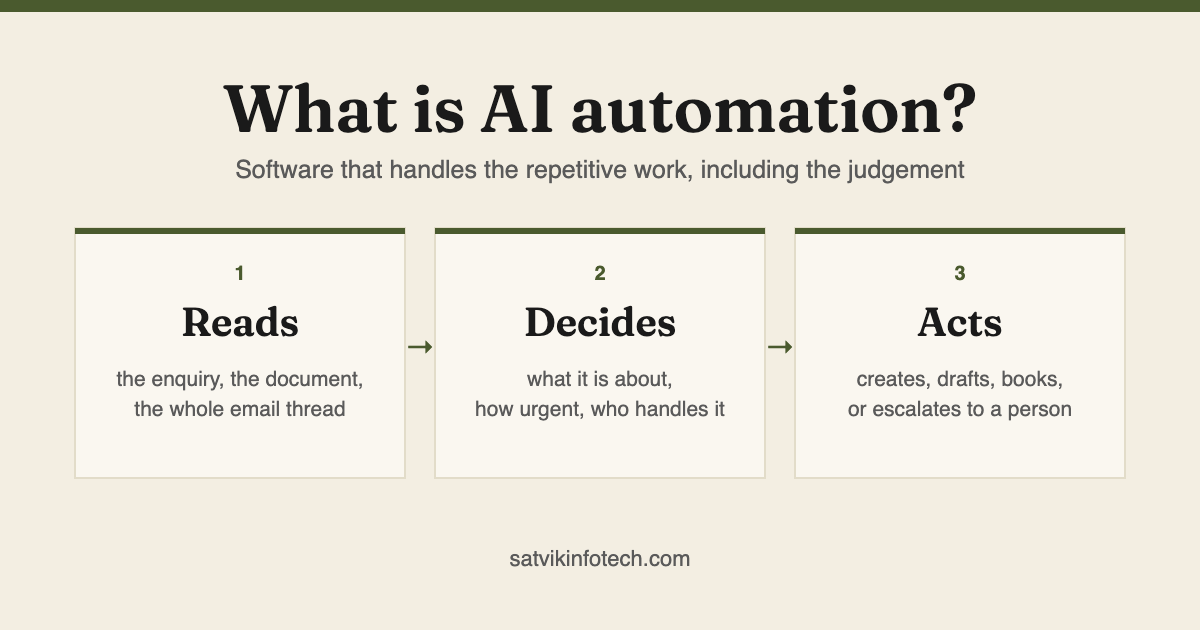
The boundary is the same one that governs any automation: a model is good at interpreting a messy request, and should be kept away from anything that commits you to a price or a promise. What AI automation actually is covers where that line sits, and replying to every enquiry in under five minutes shows the same trade-off in a much smaller build.
How to genuinely go faster
Some ways of compressing a timeline work. Others just move the delay somewhere less visible.
| Shortcut | Does it work? | Why |
|---|---|---|
| Cut features from version one | Yes, the most effective lever there is | Less to build, less to test, less to explain |
| Name one decision maker | Yes, and it costs nothing | Removes the waiting that dominates most schedules |
| Request API access on day one | Yes | Approvals run in parallel instead of blocking the build |
| Skip the design stage | No | Moves changes into the build, where they cost far more |
| Add more developers mid-build | Rarely | New people need context, which comes from the people already busy |
| Launch without monitoring | No | Saves days, then costs weeks the first time something fails quietly |
That last row is worth dwelling on. An app that breaks loudly gets fixed; one that breaks silently keeps taking enquiries and dropping them, which is the argument for monitored maintenance being part of the plan rather than an upsell after the fact.
The questions that decide your own timeline
You can narrow the range yourself, before speaking to anybody, by answering five questions honestly. Each one moves the date in a direction you can predict.
- Can you name the one job the first version must do? If the answer is a list, the list is your schedule. A single job is the shortest build there is.
- Who signs off, and how quickly? One named person answering the same week is worth more than any technical decision on this page.
- Which systems must it connect to, and do you control the access? If the CRM belongs to another team or another supplier, start that request now rather than at the point the build needs it.
- Does real content exist yet? Not the placeholder text, the actual product data, policies and wording that will be in front of users.
- What happens when the model is wrong? If you already know who checks it and what the user sees, that is a scoped build. If you do not, that conversation is the first stage, and it belongs before code rather than after the demo.
Four of those five are yours to settle, and none of them needs a developer. A business that arrives with all five answered is describing a project that can be quoted in one call, which is the same reason picking the right first automation works better than picking the biggest one.
Where cost fits into this
Time and money are the same question asked twice, because a build is mostly people. A longer scope is a bigger number, and the levers that shorten one shorten the other.
We quote per project after a free call, once the first version is actually defined. If the app needs to sit on top of a CRM, settling that first is usually cheaper than deciding it mid-build: CRM setup and management covers what that involves, and GoHighLevel and HubSpot compared is the shorter version of the decision.
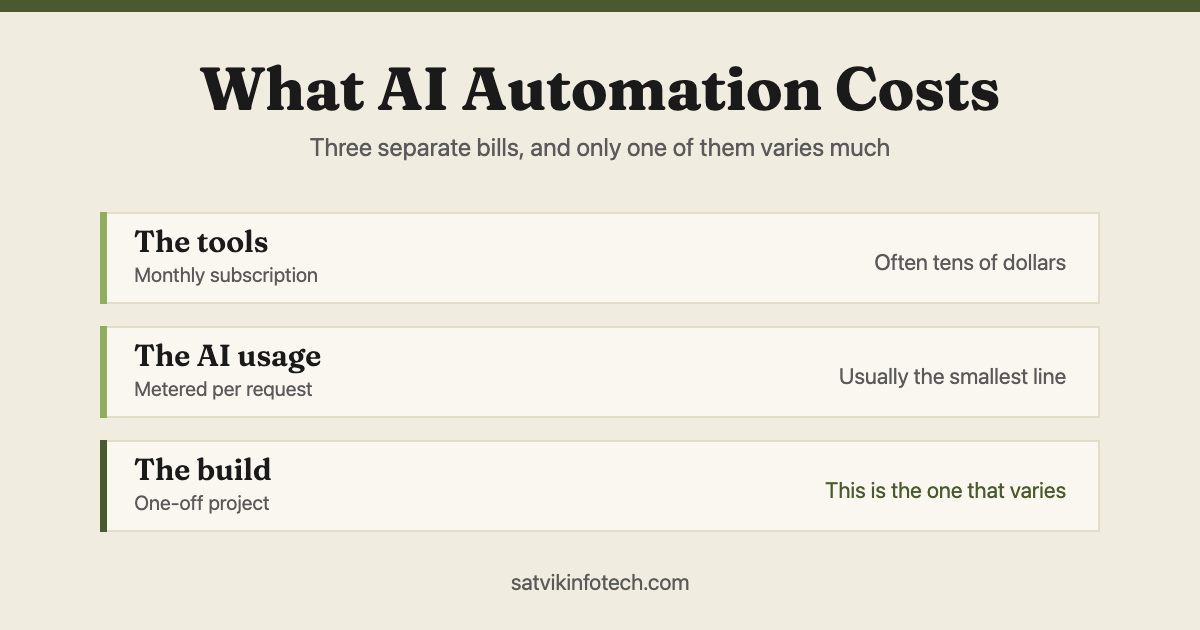
For the wider pricing picture, what AI automation costs splits the bill into tools, usage and build. Where the job is really about connecting systems rather than building a product, workflow automation is often the faster and cheaper answer, and AI automation covers the assistant-shaped work.
If the app is going to mobile, the build-approach decision moves the schedule too: cross-platform against native sets out which parts of an app have to be written twice whatever you choose. More timelines and pricing questions sit on the answers page, and if you have not settled on a builder yet, how to choose a mobile app development company covers the questions that decide whether a date is worth believing.
Common questions
How long does an AI app take to build?
A first useful version is normally a matter of weeks rather than quarters, and the exact number depends on scope, which is agreed before anyone starts. The variable that moves it most is not the engineering. It is how quickly decisions get made and how quickly access to the systems it must connect to is granted.
How long does it take to develop a custom AI application?
Longer than adding an AI feature to something you already run, and for a reason that is not about the AI. A custom application still needs accounts, permissions, an interface people can use without training and often a way to take payment, with the model as one component inside all of that. The honest range is weeks rather than quarters for a first useful version, provided that version is genuinely the smallest one that solves the problem.
Is an AI agent faster to build than an AI app?
It looks faster and often is not. An agent working across your existing tools needs very little new interface, so the build itself is smaller, but it needs credentials and permissions for every system it touches and a decision about what it may do without a person watching. Those approvals sit with other people, which is why the smallest-looking build is the one most often held up.
Why can nobody quote a timeline before scoping?
Because the same sentence describes wildly different products. "An app that reads our documents" could be one upload screen and a summary, or a permissioned archive with audit logging and half a dozen file formats. Those are not the same build, and a number given before that is settled is a guess dressed as a commitment.
Does adding AI make an app take longer?
The AI feature itself is often quick to get working and slower to make dependable. Getting a model to do something impressive once can take an afternoon. Deciding what happens on the occasions it is wrong, and building the checks and the fallback, is the part that takes real time.
What is the single biggest cause of delay?
Waiting. Waiting for a decision about what the first version includes, waiting for credentials to a system the app has to talk to, or waiting for someone to supply the real content. These are all on the client side, which is good news, because they are the ones you can control.
Can we launch faster by cutting the design stage?
Almost never. Mapping screens and flows before code is the cheapest place to change your mind, and skipping it moves those changes into the build, where each one costs far more. The stage worth cutting is scope, not design.
If you have an idea and want to know what the first version should be, that is the conversation the free call is for.